Thursday, May 12, 2016

Spice, P.Spice, B2.Spice, RF.Spice (new B2)

Needed now?


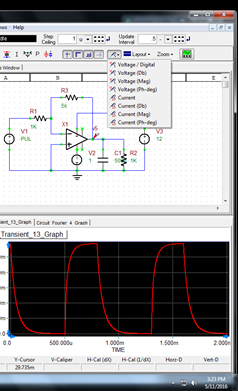
    Probes
Voltage/Digital    regular ~ used most often
Voltage (Db)        gains of amplifiers, attenuation of signals, and signal-to-noise ratios
Voltage (Mag)        not used in transient analysis
Voltage (Ph-deg)    not used, esp. not used in transient
Current        ~ used most often
Current (Db)        gain, attenuation, and signal-to-noise ratios often expressed in decibels
Current (Mag)        forget about this
Current (Ph-deg)    don’t worry about this
    • The same for current, the main choice boils down to either “Voltage/Digital” or “Voltage (Mag).”


Tests (basic)
  • Transient - time graphs ~ pulse waveform input, switching or step functions (similar modeling)
    • Real equal (critically damped) and complex (under damped) offshoots are normal. In other words, offshoots from second order and higher circuits can go over the maximum input waveform. (See Transient Analysis Quick Review.)
    • Linearize Step

    • Step Ceiling (also know as Max Time Step in this detailed post)
      • Automatically set at 1/50 simulation run time
        • If doubtfull graph, half the time for smoother or improved results

  • AC Bias - frequency response, which usually needs to be switched to a logarithmic graph
    • Edit Axis
      • Drop-down menu: Bottom Axis
        • Check logarithmic
  • Transient - oscilloscope graph ~ Circuits II; this video also goes with AC Bias
    • Setting the Stop Time
      • 1/T (inverse period)
        • allowing for 3-4 periods: demo. (same as previous hyperlink)
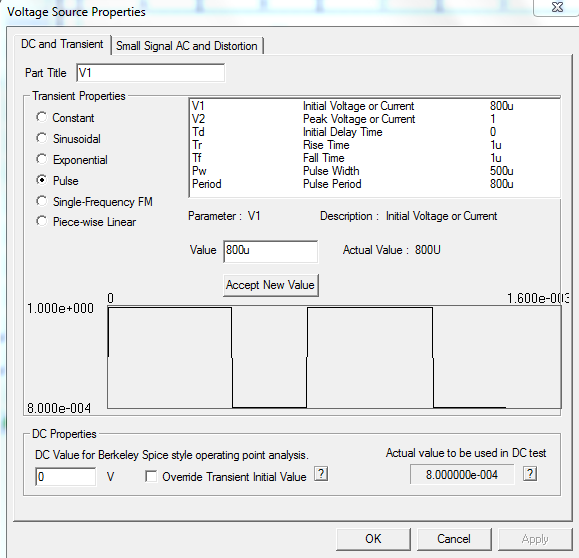
    Voltage Source Properties (click on the source)
DC and Transient - transient analysis = large signal analysis ~ most analyses
Small Signal AC and Distortion - AC analysis ~ details


Common imperfections of physical devices (source: http://spicesim.blogspot.com/p/how-to-think-like-spice.html)
Resistors
inductance for wirewound resistors
Capacitors
series resistance, especially electrolytics where resistance is large and varies strongly with frequency and temperature. Also far from perfect are ceramic caps made from high dielectric materials (Z5u, etc.).
Inductors, transformers
series resistance, self resonance with the winding capacitance (at surprisingly low frequencies) and usually a series resonance at much higher frequency. If there is a magnetic core, it may saturate and has losses that go up very rapidly with frequency.


Spice model limitation at High Frequency / fast rise time
The general purpose Spice models (.Model) for diodes, FETs and transistors do not include any lead inductance. You or the manufacturer can write a Spice .Subckt which contains the .Model plus lead/package inductances. Power MOSFETs are modeled using a .Subckt and usually have these inductances.


Switching circuits with inductors/transformers
The inductors and transformers in Spice have no winding capacitance. Switching an ideal inductor that has current flowing can result in an infinite voltage spike with zero rise time. Simulation will fail (you can almost feel the simulated gamma rays coming out of the screen). Add parallel capacitance and/or resistance to limit bandwidth and limit spike rise time/amplitude during switching.


Power supplies
Spice voltage sources turn on instantly. Real power supplies do not. This sometimes results in Spice finding a different DC Bias solution than the actual circuit has!
Spice voltage sources have such low impedance over all frequencies that they will short out DC drop, ripple and noise that would appear in any real world circuit. Consider adding series resistance (and possibly inductance).
Source: http://spicesim.blogspot.com/p/how-to-think-like-spice.html

Op-amps
Goomey's basic setup of both AC and transient analysis

Minor details
  •  Color
    • click graph
      • Edit Plot (See upper left corner of picture:)


RMS


http://physics.stackexchange.com/questions/41779/why-do-we-use-root-mean-square-rms-values-when-talking-about-ac-voltage

Impedance

Circuits I
Goomey https://youtu.be/D7JAHcKMhCs

https://youtu.be/xyMH8wKK-Ag?list=PLWUmK-m4olhEHVXnyW8HLs22vHJTT-vSf

Circuits II
https://youtu.be/tZBMfDvWF4U?list=PLWUmK-m4olhHrR1_jbTyzAJJcF0aRTdUX
http://spicesim.blogspot.com/p/measuring-ac-impedance.html

S-Domain

Once the equation is boiled down, the final two steps to do is make the numerator a polynomial (no s's with negative exponents--including #/s). And second, have the denominator's highest s-term have no constant out in front of it.

After that when finding the roots (zeros or poles, which all mean the same thing), and you're left with a complex form of something like s = α + jβ, take the (+) & (-) expression. The other expression isn't needed; in the end it equals 2||A1||cos(βt + θ)e^(-αt). And if you're lucky, you can sometimes check that time constant with regular AC analysis methods.

Tuesday, January 26, 2016

algorithm predict human behavior or yellow journalism

from
https://robindoherty.com/2016/01/06/nothing-to-hide.html

from
http://qz.com/527008/an-algorithm-can-predict-human-behavior-better-than-humans/

Deep Feature Synthesis:Towards Automating Data Science Endeavors
http://groups.csail.mit.edu/EVO-DesignOpt/groupWebSite/uploads/Site/DSAA_DSM_2015.pdf
  • must have significant data
    • data across multiple websites
      • cross-company database
        • "3 datasets from different domains"--conclusion 
  •  of course we have a pattern of what we buy
    • we buy at certain frequencies
    • we buy for certain prices, depending on our preferences/available income/etc 
    • preferences are roughly either  luxurious or economical
      • "These questions can be turned into features by following relationships, aggregating values, and calculating new features."--calculating = estimating (in the end that's all)

Saturday, January 16, 2016

Soldering


Electronics Soldering.pdf

Soldering Guide.pdf

The best way to learn soldering is by doing it on projects. Make a goal to do 10 projects in the summer. Now all you need to do is compile a list of projects. Here's what I found interesting:

DO: http://elecprojects.blogspot.com/ categorize some of these and gather supplies for 1
  1. DC power supply (converts AC to DC) Variable Voltage Power Supply
    • an inverter is the opposite
  2.  555 Timer IC Testing Circuit
  3.  Polarity cum Continuity Tester (already in DMM)
  4.  Ultrasonic Rangefinder using 8051 (make sure parts are all less than $15)
  5.  FM Bugger Circuit
  6. Other spy bugs
    1. FM
    2. Non-radio??

  7. Temperature Controlled DC Fan using Microcontroller
  8.  Car Battery Charger Circuit
  9. Mobile Jammer Circuit
  10.  TV Remote Control Jammer
  11. Password Based Door Lock System using 8051 Microcontroller
  12.  One Transistor Electronic Code Lock System
  13.  Motion Detector Circuit
  14.  Battery Level Indicator
  15.  Sun Tracking Solar Panel
  16. Metal Detector Circuit
  17. Car Parking Guard Circuit Using Infrared Sensor
  18.  Reverse Parking Sensor Circuit
  19.  8 Channel Quiz Buzzer Circuit using Microcontroller
  20.  Automatic Plant Irrigation System
  21. Wire Loop Breaking Alarm
  22. Cell Phone Detector
  23.  Transistor Intercom Circuit
  24.  Interfacing GPS with 8051 Microcontroller
  25.  Auto Turnoff Soldering Iron Circuit
  26.  Pull Pin Security Alarm System
  27.  Metal Detector Robotic Vehicle
  28.  Wireless Switch Circuit using CD4027
  29.  Automatic Street Light Controller Circuit Using Relays and LDR
  30.  12v DC to 220v AC Converter Circuit
  31.  12V to 24V DC Converter Circuit
  32.  Audio Equalizer Circuit
  33.  Toy Organ using 555 Timer IC
  34.  FM Radio Circuit
  35.  FM Remote Encoder/Decoder Circuit
  36.  Biometric Attendance System
  37. J? 
    Air Flow Detector Circuit
  38.  Stun Gun Circuit
  39.  Battery Charger Circuit Using SCR
    • Don't know what kind of batteries this can charge
      • aside, F1 = fuse
  40. How would it know what appliances to control?
Hoax?Mosquito Repellent Circuit
 Mains Operated LED Light Circuit
 RFID based Attendance System


http://www.instructables.com/id/Upcycle-your-old-PC-fans-into-mini-wind-generators/
http://www.instructables.com/id/Make-a-portable-handy-lie-detector-in-Altoid-tin/

Sources
http://www.electronicshub.org/electronics-projects-ideas/
https://learn.sparkfun.com/tutorials/how-to-read-a-schematic

Sunday, December 27, 2015

A.I. tracks

What are the different tracks that can end in, "A.I. gain[ing] the ability to improve itself, and in short order exceeds the intellectual potential of the human brain."
http://www.newyorker.com/magazine/2015/11/23/doomsday-invention-artificial-intelligence-nick-bostrom
The people who say that artificial intelligence is not a problem tend to work in artificial intelligence. [...] Oren Etzioni, the C.E.O. of the Allen Institute for Artificial Intelligence, in Seattle, referred to the fear of machine intelligence as a “Frankenstein complex.” Another leading researcher declared, “I don’t worry about that for the same reason I don’t worry about overpopulation on Mars.” Jaron Lanier, a Microsoft researcher and tech commentator, told me that even framing the differing views as a debate was a mistake. “This is not an honest conversation,” he said. “People think it is about technology, but it is really about religion, people turning to metaphysics to cope with the human condition. They have a way of dramatizing their beliefs with an end-of-days scenario—and one does not want to criticize other people’s religions.” [A digit-al god.]

Eventually, the researchers started to question the goal of building a mind altogether. Why not try instead to divide the problem into pieces? They began to limit their interests to specific cognitive functions: vision, say, or speech.

In the history of computer science, no programmer has created code that can substantially improve itself. [But it doesn't need to. Any minute measure could be replicated, improved. Unless Khatchadourian (the author of this) means that no program has been created that does anything related to 'intelligence.' Can a program edit itself? Do they merely boil down to 1s & 0s, nothing more? An example, unrelated to the last strand of thought, comes to me as voice recognition software. I'm told that it can adjust to your tendencies, but this is not intelligence in the self-autonomous realm. That is just taking a multiple of different programs and cherry picking; starting at a sub-root of the tree, {{cont. taking in reverse order}} jumping onto different limbs, then different branches, multiple trunks, stems, sub-stems, and finally (at computer computational speed), the preferred route. Just nodes on nodes.]

The book begins with an “unfinished” fable about a flock of sparrows that decide to raise an owl to protect and advise them. They go looking for an owl egg to steal and bring back to their tree, but, because they believe their search will be so difficult, they postpone studying how to domesticate owls until they succeed. Bostrom concludes, “It is not known how the story ends.”

“Artificial intelligence already outperforms human intelligence in many domains.” The examples range from chess to Scrabble.

One program from 1981, called Eurisko, was designed to teach itself a naval role-playing game. After playing ten thousand matches, it arrived at a morally grotesque strategy: to field thousands of small, immobile ships, the vast majority of which were intended as cannon fodder. In a national tournament, Eurisko demolished its human opponents, who insisted that the game’s rules be changed. The following year, Eurisko won again—by forcing its damaged ships to sink themselves.

Given even the most benign objective—to win a game—such a system, Bostrom argues, might develop “instrumental goals”: gather resources, or invent technology [...].

The brain of the village idiot and the brain of a scientific genius are almost identical. 

wtf is this saying:
A respected minority of A.I. researchers began to wonder: If increasingly powerful hardware could facilitate the deep-learning revolution, would it make other long-shelved A.I. principles viable? “Suppose the brain is just a million different evolutionarily developed hacks:

[...] deep learning. Perhaps the most interesting acquisition is a British company called DeepMind, started in 2011 to build a general artificial intelligence. Its founders had made an early bet on deep learning, and sought to combine it with other A.I. mechanisms in a cohesive architecture. In 2013, they published the results of a test in which their system played seven classic Atari games, with no instruction other than to improve its score. For many people in A.I., the importance of the results was immediately evident. I.B.M.’s chess program had defeated Garry Kasparov, but it could not beat a three-year-old at tic-tac-toe. In six games, DeepMind’s system outperformed all previous algorithms; in three it was superhuman. In a boxing game, it learned to pin down its opponent and subdue him with a barrage of punches.

DeepMind’s system still fails hopelessly at tasks that require long-range planning, knowledge about the world, or the ability to defer rewards