Wednesday, September 12, 2018

EE: FET


electronics-notes.com/articles/analogue_circuits/fet-field-effect-transistor/fet-circuit-configurations.php


Common S - medium everything (pretty much) with a 180 degree phase shift (so flipped signal)

C Drain
HIGH Zin                      low Zout
HIGH current gain        low voltage gain

C Gate
low Zin                          HIGH Zout
low current gain            HIGH voltage gain


Wednesday, August 8, 2018

LCD without pot for Arduino with menu using rotary encoder

Here's some sample code (note: will not compile) just to give you an idea:
  1. /*
  2. * Arduino LCD
  3. */
  4. #include <LiquidCrystal.h>

  5. /* Menu */
  6. #define MOVECURSOR 9 // Basically the same thing as const [whatever]
  7. const int contrast = 20; // min. PWM value
  8. const int menuTimeout = 10000; // time to timeout in a menu when user doesn't do anything.

  9. LiquidCrystal lcd(1, 2, 4, 5, 6, 7); // Arduino pins ~ creates LC object.
  10. // Parameters: (rs, enable, d4, d5, d6, d7) // LCD pins
  11. void setup() { // Setups things like bit rate or to change pins to output
  12. lcd.begin(totCols,totRows); // (width, height)
  13. }
  14. void loop() { // Iterates forever once loaded on Arduino
  15. lcd.setCursor(0,0);
  16. lcd.print("Effective Altruism movement");
  17. }
Probably eventually going to need to use this:
  1. lcd.noCursor();
  2. lcd.clear();
See electronics.stackexchange.com/a/111275/59133 with:
playground.arduino.cc/Main/TimerPWMCheatsheet
Extra - forum.arduino.cc/index.php?topic=207772.0

Toggle backlight link.

Bonus - Tinkercad keyboard + LCD
------------------------------PINOUT------------------------------


------------------------------MENU------------------------------
Delta_G recommends using his menu: 
If using, this post helps: 
  • https://forum.arduino.cc/index.php?topic=358066.msg3841709#msg3841709
My LCD screen is a 4x20 (rows by columns) with the same pinouts from the picture and schematic above. Here is my edits of Delta_G's library: 
Here is the discussion on it: 
  • https://forum.arduino.cc/index.php?topic=561064.30


Sunday, July 29, 2018

Ethernet cord

Is the bytes per second determined by the service provider for a regular ethernet cord?
I'm wondering about the most common gps when using ethernet...


It's determined by the hardware at the two ends of the wire, and what standards they have in common. Historically, 100 Mbps was the most common. 1 Gbps might be catching up now. 10, 40 and 100 Gbps are used for things like communication between servers in datacenters. 400 Gbps is coming out in the next year or so.

~ mid-2018

Transistor naming convention

https://electronics.stackexchange.com/questions/155985/why-do-the-2n2222-and-pn2222-avalanche-differently

The letter is always 'N', and the first digit is 1 for diodes, 2 for transistors, 3 for four-leaded devices, and so forth. Metal-can package can be PN2222A.

After that, it's garbage. The letters or numbers I mean.

https://www.elexp.com/Images/Reading_Transistor_Markings.pdf

Monday, April 30, 2018

Old Jetpacks


Bell Rocket Belt - status: development canceled
patentimages.storage.googleapis.com/e2/e7/86/083aa4109dcd52/US3021095.pdf
1962 by Wendell Moore
JUN2015_B01_NationalTreausre.jpgBellaircraftlogo.png
Fuel - hydrogen peroxide
Flight time - 20 sec
It works by sending the pressurized fuel through a decomposition catalyst—in this case a series of fine-meshed screens made of silver. The peroxide instantly expands into superheated steam, producing a few hundred pounds of thrust at the exhaust nozzles. These are controlled by the pilot’s hand grips. There’s no aerodynamic lift; the thing stays aloft through the physics of brute force. It has the glide angle of an Acme anvil.
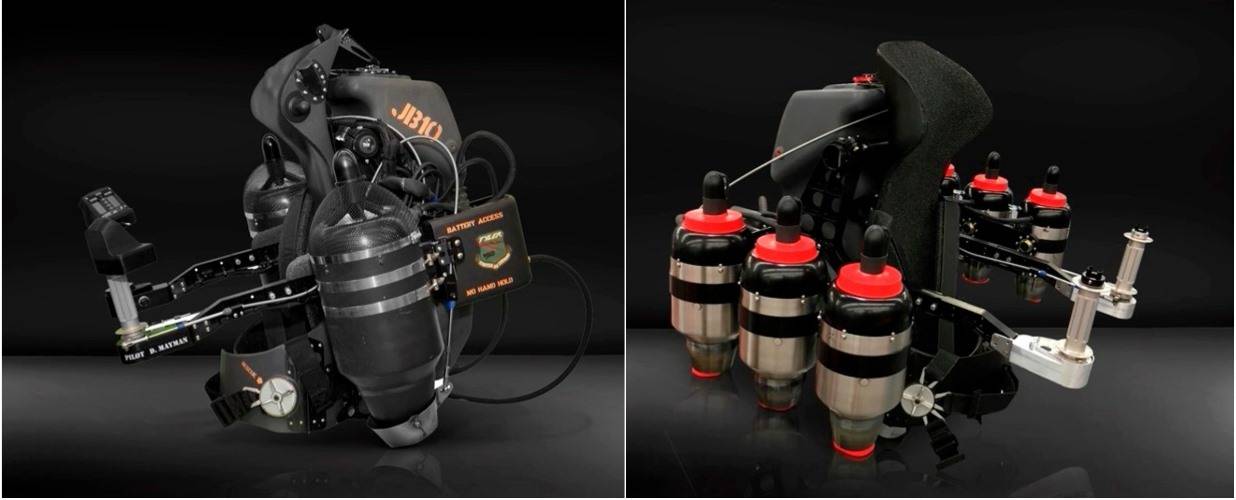
JB10 - status: retrofitted as new JB11 (see Fig. 35)
patentimages.storage.googleapis.com/c2/cc/4f/e885bd78655c95/US20170015419A1.pdf#page=28
2017 by David Mayman and Nelson Tyler
Image result for jb10 and jb11 jetpack
Fuel - kerosene or diesel
Flight time ~ 7 min