Wednesday, June 24, 2020

PV System Example

Fast facts
Should get deep-cycle because they are built for continuous power.

For discharge rates, 5-hour (0.2C) and 20-hour (0.05C), the battery performs best when discharged slowly; the capacity readings are substantially higher at a slower discharge than at the 1C-rate.

Rated capacity vs available or practical capacity:


Reserve Capacity (RC) is the number of minutes a fully charged battery at 80°F will discharge 25 amps until the battery drops below 10.5 volts. For example, "Reserve Capacity Minutes: 130".


--- --- ---

How many hours could a 100 W fridge run, per day, given a 120 W solar panel
attached to a 40-60 Ah battery?

I see 4-6 hours of peak sunlight, but it's still absorbing rays for the other hours of the day. I don't get why those hours aren't also factored in.

5hrs*120W = 600 W-hrs
600W-hrs/100 = 6 hours of time the fridge could run?

--- --- ---

Technically a solar panel will output some voltage at all hours, but little current. Anything except full sun is practically nothing. And a panel "rated" for 120W is under ideal circumstances - they never reach this in reality. My gut is saying that the battery will eventually cycle near empty.
Actual output in volts, amps, and wattage from a 100 Watt Solar module in August.jpg

--- --- ---

Cycle near empty meaning destroy the battery?

--- --- ---

Depends on the battery chemistry. Some types, like lead-acid cannot take being completely discharged. All battery types - the deeper you discharge and recharge them, the shorter they will last.

--- --- ---

Yes, but I mean lead-acid.
Probably will be that anyway:
Hmmm, 18 V

--- --- ---

If you don't already own the fridge, you might do better (efficiency and run time wise) to get a mini fridge made to run on 12V. That saves you the losses in the inverter, and reduces the current drawn from the battery.

--- --- ---

I have an energy star rated mini-fridge. I also have a bunch of reflectix and think buying some insulation will be better than buying another mini-fridge.

--- --- ---

If it's "Energy Star" rated, then there ought to be information on its energy consumption available. Energy star rated appliances are supposed to tell you the energy consumption for one year of operation. From that you can find the average energy for one day.

--- --- ---

Example 
319 kWh/year
(319000 Wh)/365 = 874 Wh/24h
874 Wh/day or, with 80% efficient inverter and assuming 12 V, that's (874/12V)*1.2 = 88 Ah.
Therefore, at least two 75 Ah batteries are needed.

$100 for 75 Ah 
https://www.batteriesplus.com/productdetails/battery/marine-and-boat/deep-cycle/bci-group-24m/sli24mdc

$90 for 65 Ah
https://www.batteriesplus.com/productdetails/battery/marine-and-boat/deep-cycle/bci-group-24m/sli24mdp

https://www.directenergy.com/learning-center/how-much-electricity-does-my-refrigerator-use


This calculator spits out that for a ??? W fridge (running off AC power), given 5 hours of direct sun--needs ??? watt PV system!


 Min   Max 
Spec (per)
Quantity   $  356.00  $  429.00
70 Ah Battery 2  Total 


 $  150.00
Charge controller 1  $    14.00  $    24.00
100-150 W PV cells 2  $  137.00  $  200.00
750 W Inverter 1  $    55.00

Extra

Sunday, May 3, 2020

Patent Attorney

STEM is required for patent prosecution, but not patent litigation. To be patent barred, you need a degree in STEM.

Need to take the LSAT.

Go for a T14 school, don't settle for a cheaper:

A lot of firms only hire from the top 10% of schools, but will hire from any part of a T14 class.

You're a splitter if you have a low GPA and a high LSAT and you're a reverse splitter if you have a low LSAT and high GPA

If you want to stay in Chicago, Loyola is your next best bet ESPECIALLY for IP. Very strong IP program. John Marshall and DePaul also have decent IP placement

Friday, August 9, 2019

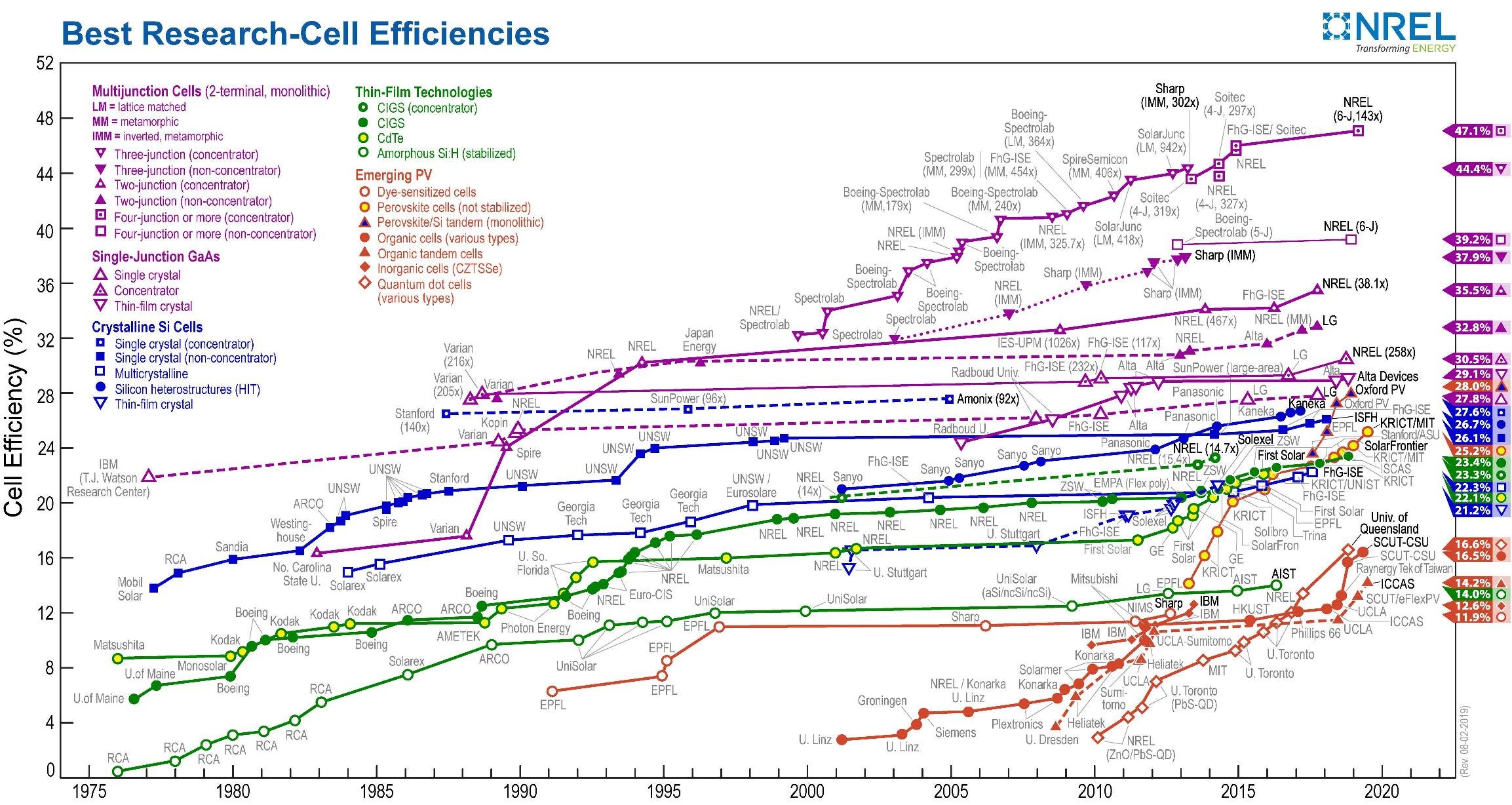
PV cell efficiency


  • Solar panels are limited to the infalling solar radiation: 1000 W per square meter at high noon in the Sahara. 
  • Solar cells run about 20% efficiency, so you can get around 200 W per square meter (or per 10.8 sq feet) in full sunlight. Some exceptional panels get more than 20%.
  • The solar cells aren't the main limitation: it's the sun. In any case you are limited to 1000 W/m^2, which is at 100% efficiency.
  • For example
    • 9kw power generation
      • 3'x30' array of theoretically perfect solar cells.

Wednesday, August 7, 2019

SPI


I’d recommend reading the “operation” section of the SPI wiki: https://en.wikipedia.org/wiki/Serial_Peripheral_Interface
Just a quick heads up:
  • DO (data out), SDO (serial data out), MOSI (master out, slave in)                      all mean the same thing
  • DI (data in), SDI (serial data in), MISO (Master In, slave out)                             all mean the same
  • /CS (chip select), /SS (slave select), nCS, nSS                                                      all mean the same thing
    • Both ‘n’ and ‘/’ mean the signal is active low, not active high


The basic concept of SPI is that the master initiates every communication.  Also one bit is sent by both the master and the slave on every clock edge. 

Say you want to read two pieces of data from the slave, you can chain commands together.
MOSI     [Read command 1]          [Read command 2]          [don’t care]
MISO     [don’t care]                        [Response 1]                     [Response 2]
Note the slave can’t respond until it’s received all of command 1.  In this example, command 2 provides the clock edges for the slave to respond with. 
At the end, the master must clock an additional packet in (the don’t care above) to get the final response out. 

Moving up the chain in complexity is independent slaves:

The clock, MOSI and MISO lines are shared.  Each slave has a chip select (/SS) and responds when addressed.

Moving up the chain again is daisychained slaves.
If I want to talk to green, I feed one packet in to write the command.  Green sends its response to blue, and blue sends its response to purple, and purple to master.
If you want, you can command all three at once, but you’ll need to send a bunch of don’t care data to flush the shift register and make sure Blue doesn’t try and use green’s response as a command.

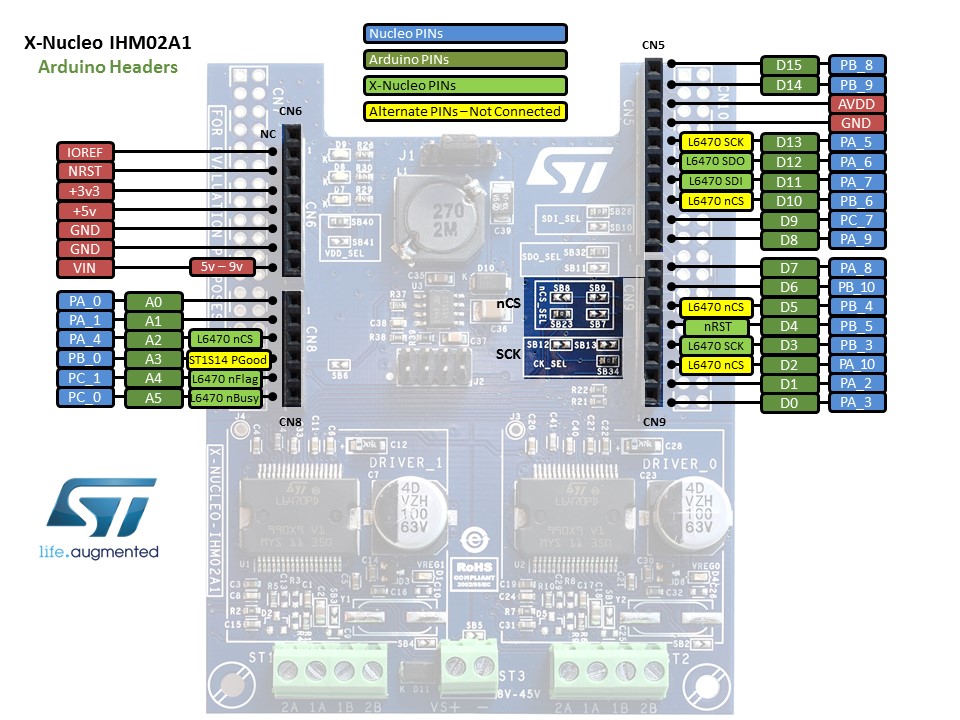
Looking at the Nucleo schematic, you’ll notice L6470_1_SDO (Serial Data Out) is connected to L6470_0_SDI (Serial Data In).  This is a daisy chain configuration. Also note how the bridging SB7 leads to the D2 pin on the board. 
Looking at the part datasheet, it will start reading data when /CS is low, and will keep shifting data out until /CS is high.


By stacking a second board, this configuration results—it’s a combination of both the daisy chain and individually addressed version above:


Motor 1 and 2 move, so nCS1 is working. 
Probing nSS2dd with the scope—should jump between 5v to 0v—which it's not...


All four nCS's are connected in the middle (as shown on the right in red).